
Introduction
Peptides are involved in countless processes throughout the human body, from regulating metabolism and appetite to supporting immune responses and communication between cells. But how do peptides work, and why can two peptides produce completely different effects?
At their simplest, peptides are short chains of amino acids that can act as biological messengers. Many naturally occurring peptides help cells communicate by interacting with specific receptors. When a peptide binds to a compatible receptor, it can activate a signaling pathway inside the cell, leading to a particular biological response. Depending on the peptide and its target, that response might influence hormone release, metabolism, inflammation, growth, or other physiological functions (Abid et al., 2021).
However, peptide signaling is more complex than a simple lock-and-key relationship. Different peptides have different structures, targets, and functions, and some can interact with more than one receptor. Researchers study these natural signaling systems not only to understand human biology but also to develop peptide-based medicines that can target specific biological pathways (Wang et al., 2022).
Understanding this basic process makes it much easier to separate the actual science of peptides from many of the claims surrounding them online.
What Happens When a Peptide Enters the Body?
What happens to a peptide depends greatly on where it comes from and how it reaches its target. The body naturally produces many peptides as part of normal physiological processes. These peptides are often synthesized as larger precursor molecules that are processed into smaller, biologically active forms before being released where they are needed.
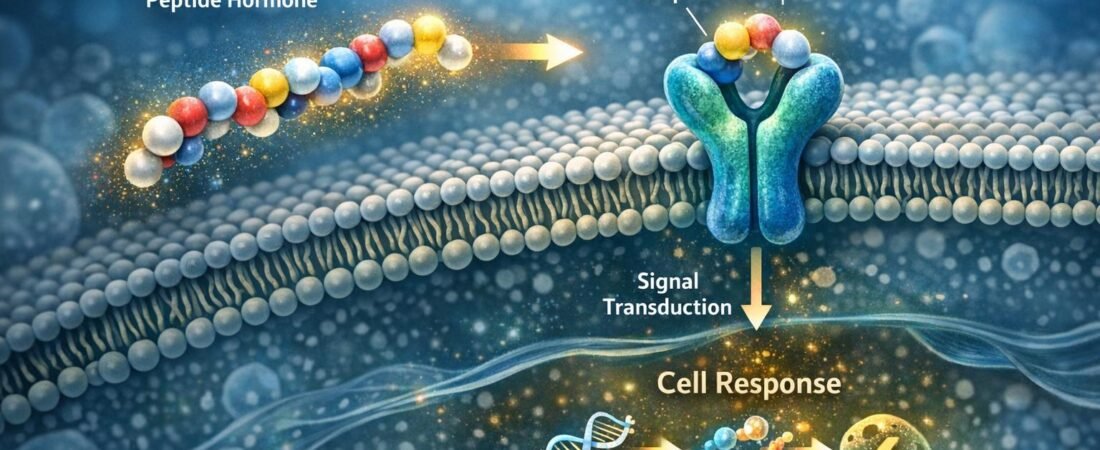
Once released, many peptide hormones and signaling peptides travel through body fluids or act locally near the cells that produced them. When they reach a target cell, they may bind to a specific receptor on the cell surface. This interaction can activate signaling mechanisms inside the cell, allowing an external peptide signal to influence cellular activity (Culhane et al., 2015).
Importantly, peptides do not all travel to the same tissues or produce the same response. Their effects depend on factors such as their amino acid sequence, three-dimensional structure, receptor affinity, and where compatible receptors are located. This helps explain why one peptide may influence metabolic processes while another participates in growth, immune signaling, or hormone regulation (Wang et al., 2022).
Peptides also have limited lifespans in the body. Enzymes called proteases and peptidases can break peptide bonds and ultimately reduce peptides into smaller fragments or amino acids. This natural degradation is one reason researchers must consider peptide stability and duration of action when developing peptide-based therapies (Wang et al., 2022).
How Peptides Communicate With Cells
One of the most important functions of peptides is helping cells communicate. Many signaling peptides work by binding to receptors located on the surface of target cells. A receptor can recognize particular molecular features of a peptide, allowing the peptide to initiate a biological signal without necessarily entering the cell itself.
After a peptide binds to its receptor, the receptor can trigger a series of events inside the cell known as a signaling pathway. For example, many peptide hormones interact with G protein-coupled receptors (GPCRs). Activation of these receptors can influence intracellular messengers, enzymes, ion channels, and eventually cellular functions or gene activity (Culhane et al., 2015).
This receptor specificity is one reason different peptides can have very different effects. A peptide can only directly signal through cells that contain receptors capable of responding to it. Even then, the resulting effect may vary depending on the tissue and signaling pathway involved. Research has also shown that peptide-receptor relationships can be more complex than the traditional idea that one peptide communicates with only one receptor (Abid et al., 2021).
In simple terms, the process can be pictured as:
Peptide signal → receptor binding → intracellular signaling → biological response
This communication system allows the body to coordinate numerous processes, including metabolism, appetite, stress responses, reproduction, growth, and other aspects of normal physiology.
Examples of Peptides and What They Do in the Body
The human body produces many different peptides, and their functions extend far beyond a single biological process. Looking at familiar examples helps explain why the word “peptide” describes a broad class of molecules rather than one particular type of treatment.
Insulin is one of the best-known peptide hormones. Produced by pancreatic beta cells, insulin helps regulate blood glucose by signaling cells to take up and use glucose and by influencing how the body stores nutrients. Its discovery and therapeutic development also represent an important milestone in the history of peptide-based medicines (Wang et al., 2022).
Glucagon-like peptide-1 (GLP-1) is another naturally occurring peptide involved in metabolic regulation. It is released from the intestine following food intake and participates in glucose-dependent insulin secretion, appetite regulation, and other aspects of metabolic signaling. The biological actions of GLP-1 have also provided the foundation for developing medications that target the GLP-1 receptor.
Other peptide hormones have very different roles. Oxytocin, for example, participates in reproductive processes, including uterine contractions and milk ejection, while vasopressin contributes to the regulation of water balance and vascular function. These examples demonstrate how different peptides can act through specific receptors and signaling pathways to influence distinct physiological processes (Wang et al., 2022).
The key point is that peptides should not be treated as though they all produce similar effects. Their biological actions depend on their structure, receptors, target tissues, and signaling pathways. Understanding those differences is essential when evaluating claims about individual peptides.
Why Peptides Can Have Such Different Effects
Although all peptides are made from amino acids, small differences in their amino acid sequences and three-dimensional structures can lead to very different biological functions. A peptide’s structure influences which receptors it can interact with, how strongly it binds, and what signaling pathways may be activated.If you’re wondering how peptides differ from larger protein molecules, our guide to peptides vs. proteins explains the distinction.
Receptor distribution also matters. Receptors are not distributed equally throughout the body, so a peptide may have stronger effects in tissues where its corresponding receptors are more abundant. Once a receptor is activated, the response can also vary according to the cell type and the intracellular signaling mechanisms involved (Abid et al., 2021).
This helps explain why it is misleading to discuss “peptides” as though they represent a single treatment with a common set of benefits. Insulin, oxytocin, vasopressin, and GLP-1-related peptides are all peptides, yet they participate in very different physiological processes. Each must be evaluated individually based on its mechanism, supporting evidence, safety profile, and intended use (Wang et al., 2022).
Researchers can also modify peptide structures when developing medicines. These changes may be designed to improve properties such as stability, receptor selectivity, or duration of action. As a result, a therapeutic peptide inspired by a naturally occurring molecule may not behave exactly like the original peptide produced by the body (Wang et al., 2022).
This diversity is one of the most important concepts to remember when encountering broad claims about peptides online: evidence about one peptide cannot automatically be applied to another.
Natural Peptides vs. Peptide-Based Medicines
It is important to distinguish between peptides that occur naturally in the body and peptide-based medicines developed for therapeutic purposes. Natural peptides are produced by the body and participate in normal physiological processes such as metabolism, growth, reproduction, appetite regulation, and cellular communication.
Peptide-based medicines are developed to influence specific biological pathways for therapeutic purposes. Some are based closely on naturally occurring human peptides, while others are modified to improve characteristics such as stability, receptor selectivity, or duration of action. Insulin is a well-established example of a peptide used therapeutically, while other peptide-based drugs target pathways involved in metabolic, endocrine, and other health conditions (Wang et al., 2022).
One challenge is that natural peptides can be broken down rapidly by enzymes in the body. They may also have difficulty crossing certain biological barriers. Researchers therefore use strategies such as modifying amino acid sequences or molecular structures to make therapeutic peptides more resistant to degradation and suitable for clinical use (Wang et al., 2022).
The term “peptide” also does not mean that a substance is automatically safe, effective, or medically approved. A peptide discussed in early laboratory research is very different from a peptide-based medicine that has undergone clinical testing and regulatory review. Claims about any individual peptide should therefore be evaluated according to the evidence supporting that specific compound rather than assumptions about peptides as a whole.
Why Some Peptides Are Difficult to Take Orally
One of the major challenges in developing peptide-based medicines is getting the peptide to its intended target in an active form. Unlike many conventional small-molecule drugs, peptides generally have poor oral bioavailability.
When a peptide is swallowed, it encounters the harsh environment of the gastrointestinal tract. Stomach acid and digestive enzymes can break peptide bonds and degrade the molecule before enough of it can be absorbed. Even when a peptide survives digestion, its relatively large molecular size and other chemical properties can make crossing the intestinal barrier difficult (Wang et al., 2022).
These limitations help explain why many peptide-based medicines have traditionally been administered through injections rather than conventional tablets or capsules. However, this does not mean that oral peptide medicines are impossible. Researchers have developed formulation and delivery strategies designed to protect certain peptides from degradation and improve their absorption.
The route of administration therefore matters when evaluating peptide products. Simply placing a biologically active peptide into a capsule does not guarantee that meaningful amounts will survive digestion, enter circulation, and reach the intended target.
This is also why consumers should be cautious about broad marketing claims surrounding oral peptide products. Evidence that a peptide has a particular biological function does not automatically demonstrate that every supplement containing or claiming to contain that peptide will reproduce the same effect in the human body.
What Happens to Peptides After They Have Done Their Job?
Peptide signals generally do not remain active indefinitely. The body has mechanisms for controlling how long these molecules circulate and how long their biological effects continue. This is important because prolonged or uncontrolled signaling could interfere with normal physiological regulation.
Many peptides are eventually broken down by enzymes known as proteases and peptidases. These enzymes cleave peptide bonds, producing smaller peptide fragments and amino acids that can be further processed or reused by the body. Some peptides may also be removed from circulation through organs such as the liver and kidneys (Wang et al., 2022).
The rate at which this happens varies considerably among peptides. Some naturally occurring peptides have very short half-lives because they are rapidly degraded, while others remain active for longer periods. Their structure, location, interactions with enzymes, and route of administration can all influence their stability.
For therapeutic peptides, a short half-life can present a challenge because the medication may not remain active long enough to produce the desired effect. Researchers can sometimes modify peptide molecules to make them more resistant to enzymatic breakdown or otherwise extend their duration of action (Wang et al., 2022).
Ultimately, peptide breakdown is part of the body’s normal regulatory system. A peptide sends or influences a biological signal, and mechanisms for degradation and clearance help prevent that signal from continuing indefinitely.
Do All Peptides Have Proven Health Benefits?
No. The fact that a peptide has biological activity does not automatically mean that it provides a proven health benefit. This distinction is especially important because peptides are increasingly discussed online in connection with weight management, recovery, muscle growth, skin health, longevity, and other wellness goals.
The strength of evidence varies substantially from one peptide to another. Some peptide-based medicines have been extensively studied in humans, evaluated in clinical trials, and approved for specific medical uses. Other peptides may have evidence primarily from laboratory experiments, animal studies, small human studies, or early-stage research. Findings from these early stages can help researchers identify promising directions, but they cannot automatically establish safety or effectiveness in people (Wang et al., 2022).
It is also important to separate a peptide’s biological mechanism from a demonstrated clinical outcome. Knowing that a peptide interacts with a particular receptor or signaling pathway does not prove that using that peptide will produce a meaningful health benefit. Dose, delivery method, stability, target tissue, side effects, and many other factors can influence the outcome.
For consumers, this means peptide claims should be evaluated individually. Useful questions include whether the peptide has been studied in humans, what type of study was conducted, whether the findings have been replicated, and whether the specific use being promoted is supported by evidence.
In short, “biologically active” and “clinically proven” are not the same thing. Maintaining that distinction is essential for understanding peptide research without turning promising science into exaggerated health claims.
The Bottom Line: How Do Peptides Work?
So, how do peptides work in the body? The answer depends on the specific peptide, but many function as biological messengers that help cells and tissues communicate. They can interact with specific receptors, activate signaling pathways, and influence processes ranging from metabolism and appetite to reproduction, growth, and other physiological functions (Abid et al., 2021).
The basic process can often be summarized as:
Peptide → receptor interaction → cellular signaling → biological response
However, that simple pathway does not mean all peptides work in the same way. Their effects depend on their amino acid sequence, structure, target receptors, tissue distribution, stability, and numerous other biological factors. The body also regulates peptide activity through processes such as enzymatic degradation and clearance.
Peptide science has already contributed to important medicines, and researchers continue to investigate new therapeutic applications. At the same time, emerging research should not be confused with established clinical evidence. A promising mechanism in a laboratory does not necessarily translate into a safe or effective treatment in humans (Wang et al., 2022).
That distinction is especially important as peptides become increasingly visible in health and wellness conversations. Rather than treating peptides as a single category of “beneficial” compounds, each peptide should be considered individually based on the quality of evidence behind it.
Understanding how peptides work provides a foundation for doing exactly that: following the science, recognizing what is established, and remaining clear about what researchers are still discovering.
References
Abid, M. S. R., Mousavi, S., & Checco, J. W. (2021). Identifying receptors for neuropeptides and peptide hormones: Challenges and recent progress. ACS Chemical Biology, 16(2), 251–263. https://doi.org/10.1021/acschembio.0c00950
Culhane, K. J., Liu, Y., Cai, Y., & Yan, E. C. Y. (2015). Transmembrane signal transduction by peptide hormones via family B G protein-coupled receptors. Frontiers in Pharmacology, 6, 264. https://doi.org/10.3389/fphar.2015.00264
Wang, L., Wang, N., Zhang, W., Cheng, X., Yan, Z., Shao, G., Wang, X., Wang, R., & Fu, C. (2022). Therapeutic peptides: Current applications and future directions. Signal Transduction and Targeted Therapy, 7, 48. https://doi.org/10.1038/s41392-022-00904-4